

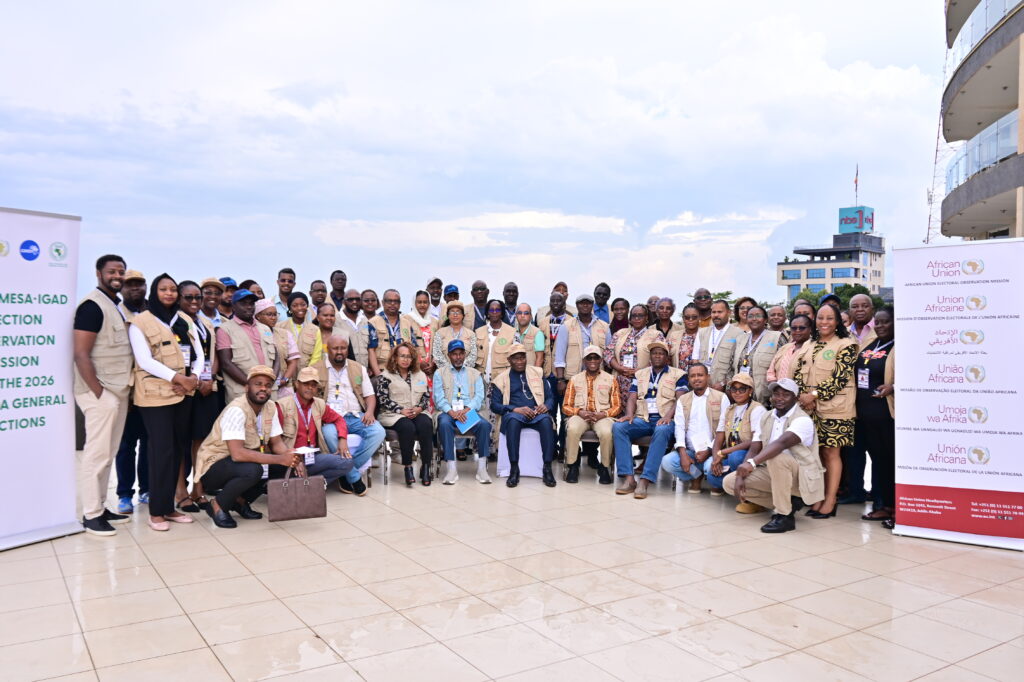
The Joint African Union-COMESA-IGAD Election Observation Mission that deployed to the 15 January 2026 General Elections has commended Uganda for holding regular elections as enshrined in their national constitution. The Mission has also noted that the elections were delivered in a calm environment compared to the 2021 elections.
However, the Mission expressed concern with reports of harassment, intimidation and arrest of opposition leaders, candidates, supporters, media and civil society actors, as well as the suspension of Non-Governmental Organisations (NGOs) and the internet shut down.
Head of the AU-COMESA-IGAD Observation Mission H.E. Goodluck Jonathan pointed out that in view of these findings, the Mission has offered several recommendations to support Uganda’s continued democratic consolidation.
The recommendations are directed to the government, parliament, electoral commission, security agencies and political parties. President Jonathan Goodluck said this in Kampala during the issuing of the Mission’s Preliminary Statement. Dr Jonathan, who is the former President of Nigeria was assisted by Ambassador Shemsudin Ahmed Roble, Member of the COMESA Committee of Elders, and Commander Abebe Muluneh Beyene, Director of Peace and Security, representing Intergovernmental Authority on Development (IGAD)
The preliminary statement among others urged the Government to safeguard the right to information, fundamental freedoms of expression, assembly, association, throughout the electoral cycle, in line with constitutional and international obligations. The statement further urged the Government to avoid suspending access to the internet close to the elections and devise alternative mechanisms of handling potential security threats.
“They should provide a conducive and favourable environment for operation of civil society, traditional and new media as well as the opposition parties as key actors in delivering credible and transparent elections,” Dr Jonathan said.
Parliament on other hand was urged to undertake electoral reforms ahead of future elections through broad-based consultations with political parties, civil society organisations and other stakeholders. This will help address persistent legal, institutional and operational gaps identified across electoral cycles. The proposed legal reforms should include enacting a campaign financing law that provides for clear spending limits and effective enforcement mechanisms to curb the commercialisation of elections.
The Electoral Commission (EC) was urged to ensure the consistent application and respect of the Constitution and electoral laws, without any interference. The EC was urged to consider introducing a waiver or reduction of nomination fees for women, youth and candidates with disabilities to incentivise and enhance their participation in competitive elections.
On the use of new technologies specifically the BVVKs, the EC was urged to conduct robust test-runs before voting day to ensure their effective use on the actual voting day. The EC should invest in desegregation of election data based on age, gender and disability data.
Security agencies were urged to operate within the law and mandate in a manner that is proportionate, impartial, and respectful of human rights. For political parties, they should promote internal party democracy, introduce quotas in all leadership positions and equitable access to campaign resources, particularly for women, youth and marginalised groups.
The AU-COMESA-IGAD Mission comprised of 84 Short-Term Observers drawn from 27 African countries who included ambassadors, officials of election management bodies, civil society organisations, election experts, academics, human rights practitioners, gender and media specialists and youth representatives.
Among the joint Mission’s objectives were to demonstrate AU–COMESA–IGAD’s solidarity with the people of Uganda in their democratic and electoral processes, ultimately contributing to peace, stability, good governance and inclusive development.