



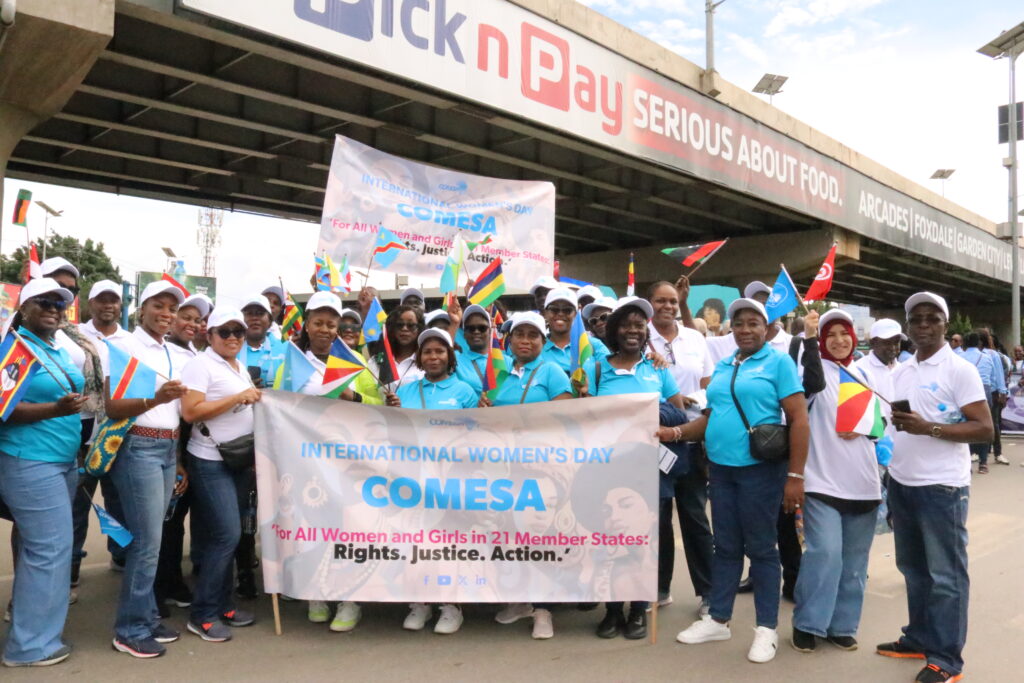
The Common Market for Eastern and Southern Africa (COMESA) joined the international community in commemorating International Women’s Day 2026 under the theme “Rights. Justice. Action. For All Women and Girls.” Highlighting the resilience, innovation, and leadership of women across its 21 Member States, H.E. Secretary General (SG) Chileshe Mpundu Kapwepwe reaffirmed the organisation’s commitment to advancing gender equality as an essential pillar for regional integration and sustainable development.
In her message to mark the day, Ms Kapwepwe said Women and girls make up more than half of COMESA’s 680 million citizens and are recognized as key drivers of growth, trade, agriculture, innovation, and peace. However, she noted persistent challenges facing women, including structural discrimination, economic vulnerability, and limited access to digital technologies, finance, land and decision-making opportunities. Gender-based violence remains prevalent, with an estimated one in three women in the region experiencing physical or sexual violence in their lifetime. Women in informal and cross-border trade, who constitute 70% of small-scale traders, are particularly vulnerable to harassment and unsafe working environments.
“Addressing these disparities is not only a matter of social justice but a strategic imperative for inclusive and sustainable regional integration,” Ms Kapwepwe stated. The bloc highlighted its commitment to promoting gender-responsive policies and strengthening institutional capacity to support women’s economic and social empowerment.
Key initiatives such as the Simplified Trade Regime and the Small-Scale Cross-Border Trade Initiative, which aim to improve border conditions and ensure safer, more predictable environments for women traders were mentioned as some of the key drivers of change. The Great Lakes Trade Facilitation Project has also enhanced public-private dialogue at border points, enabling women to voice concerns and influence trade reforms.
In the energy sector, the ASCENT Programme was highlighted as it ensures women benefit from clean energy access and leadership opportunities. Digital empowerment is driven by the 50 Million African Women Speak Platform, which expands digital and financial inclusion for women entrepreneurs across the region.
COMESA has also established a regional database profiling women- and youth-owned enterprises to inform policies and support targeted interventions. Capacity-building efforts continue to strengthen women’s participation in leadership and governance.
As International Women’s Day is celebrated, COMESA through the Secretary General urged governments, the private sector, and civil society to collaborate in removing barriers facing women and investing in women-centered programs. “Gender equality is the foundation for inclusive regional integration. When women thrive, economies grow,” the SG’s statement emphasized. COMESA called for bold action and partnership to advance rights, justice, and opportunities for all women and girls.