



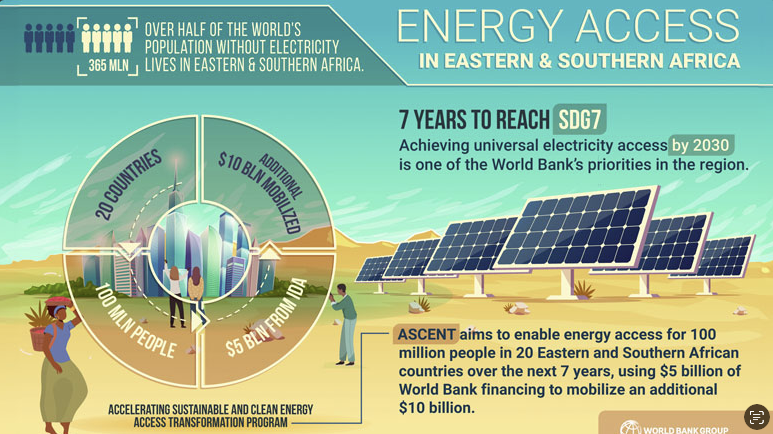
The momentum behind Africa’s energy transformation continues to build, with the World Bank revealing that the ASCENT Programme has already connected over 39 million people to electricity from the targeted 300 million people in Sub Saharan Africa since its launch in June 2024. The update drawn from the programme’s publicly available tracker, updated every six months was shared during the official opening of the ASCENT Carbon Days event in Nairobi on 10 February 2026.
Addressing delegates from across Eastern and Southern Africa, Mr Eric Fernstrom, the World Bank Group’s Regional Director for Infrastructure, described the milestone as a powerful demonstration of what coordinated investment, strong government leadership, and regional collaboration can achieve. The World Bank, he noted, is currently supporting progress through more than 150 energy projects spanning the full value chain.
“About a year after the launch of the ASCENT Programme, we are already at 39 million people connected,” Fernstrom said. “You can follow the progress on our public tracker, which publishes new data every six months.”
Mr Fernstrom commended the COMESA Secretariat and partners of the ASCENT Regional Knowledge Platform for convening key stakeholders in the carbon market space and fostering an environment where countries can exchange knowledge and build shared capacity for carbon market innovation.
A major focus of the Nairobi gathering was the region’s growing opportunity to leverage carbon finance as a catalyst for expanding clean energy access. Mr Fernstrom emphasized that significant groundwork has already been laid to unlock this potential, particularly through ASCENT’s efforts to strengthen digital Monitoring, Reporting, and Verification (dMRV) systems that ensure the integrity of emission reduction credits.
He reiterated the alignment between ASCENT and Mission 300, the flagship initiative led by the World Bank Group, the African Development Bank, and other partners, which aims to connect 100 million people in Sub Saharan Africa to reliable and affordable electricity by 2030.
The meeting heard that if ASCENT countries successfully bring their projected emission reduction credits to market, they could collectively generate over one billion dollars in carbon finance.
Importantly, the Director clarified that carbon finance is not meant to serve as profit from individual projects—but rather as a renewable funding stream to expand more projects, scale faster, and reach underserved communities more effectively.
With ASCENT Carbon Days now underway, the region stands at a pivotal moment—one where strong climate ambition, digital innovation, and collaborative action can redefine the future of clean energy access across Eastern and Southern Africa.